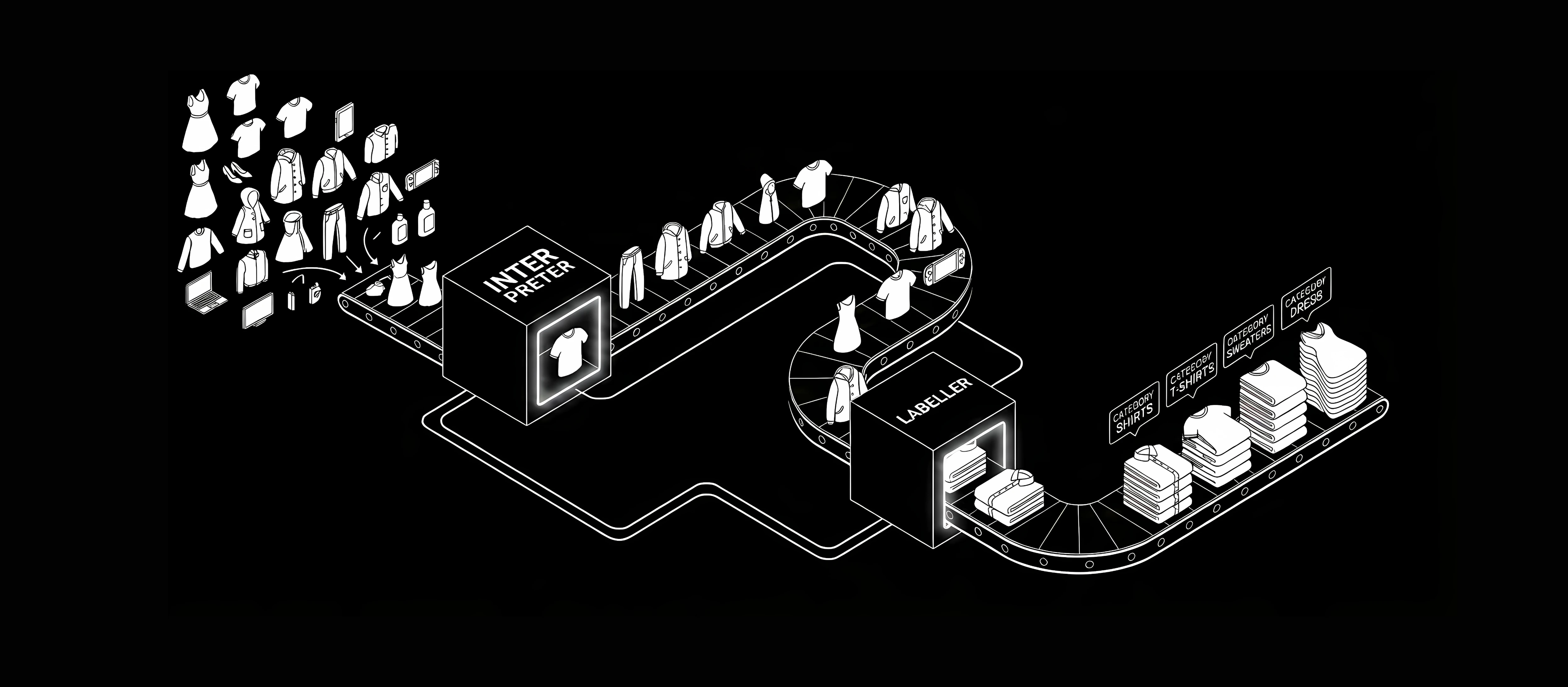
A 27x catalog scale-up.
The AI classifier didn't just save time, it protected the catalog architecture from being quietly degraded by everyone who touched it downstream.
Role
Design Lead
Company
Mula
Timeline
September 2025 - January 2026
Team
Product Manager, Engineers
01 / The Challenge
Onboard 8000 new products in a catalog of 300
Mula was expanding its merchandise catalog from 300 products to 8,000, on a tight timeline. My job was to design the taxonomy that would govern how all of them were navigated, across two substantially different catalogs and three supplier structures that had never been unified.
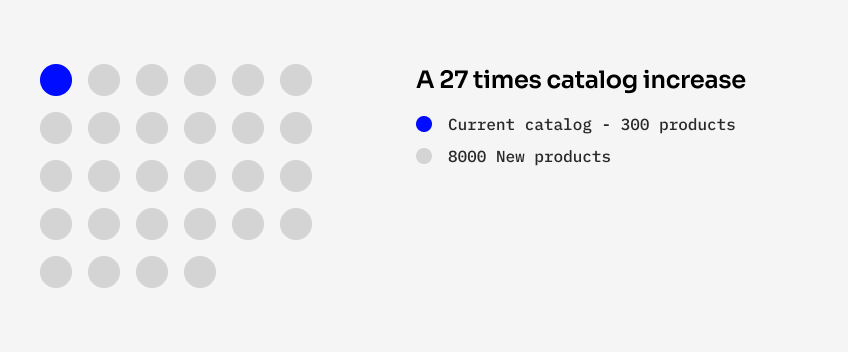
Eight thousand products can't be crammed into a taxonomy built for three hundred. This needed a new catalog architecture, designed from the ground up to host a fundamentally different scale.
The Stakes
02 / The Architecture Decision
No time for a fresh build
The first instinct was to map everything to Mula's category tree. A few days cross-referencing the new supplier catalogs made it clear that our current category tree and the new ones had fundamentally different scopes, and mapping to Mula's was not an option.
The time pressure did not allow us to build a new taxonomy from scratch to support such a vast amount of products. The smarter move: review the new supplier catalog taxonomies, assess which one had the strongest fundamentals, use it as the reference, and map the other catalogs onto it.
03 / The Approach
Mapping categories across trees was not enough
With the reference taxonomy defined, category mapping was supposed to handle most of the volume. Nevertheless, a few days into the task revealed that it would not be that simple.
The problem: supplier category names were meaningless as mapping rules. A broad category like Kitchen Accessories did not have a clean mapping. In practice, the only way to understand its actual scope was to open that category in the supplier's catalog and check every article inside, often belonging to several categories on the reference tree. What looked like one mapping decision was in reality dozens, each item assessed individually.
At scale that meant thousands of individual category decisions made downstream by people without the taxonomy knowledge I had, each one potentially degrading the new taxonomy's integrity. The consequences of handing the manual mapping to Catalog Management, and the risk of progressive miscategorisation, were concrete and expensive:
01 · Consequence
A miscategorised product is a product customers can't find.
02 · Consequence
Items placed in the wrong category erode customers' trust.
03 · Consequence
The manual path cost grows with every new supplier onboarding.
04 / The Solution
Automate product categorisation using AI
I wanted to test whether product categorisation could be automated instead of being carried out manually. The idea was to feed basic product information, name, description, and image, into an agentic pipeline that assigned each product to its correct 3-level category node.
Four problems, four lessons
Four distinct problems surfaced across iterations, each one producing a unique learning and driving a complete shift in engineering strategy:
Problem
No sample cap on the first run; cost surfaced immediately and was hard to defend before the approach was proven.
Lesson
Prove it on a reduced sample first. Scale is cheap once it works, expensive when it doesn't.
Problem
Feeding images forced a vision model 15x more expensive. HTS codes carried precise functional information and ran on a cheaper text model.
Lesson
Match the input to the task. The right data point beats a bigger model.
Problem
Extensive prompt iteration just shifted errors around. The model wasn't failing on instructions, it was failing under architectural load.
Lesson
When fixing one thing keeps breaking another, the architecture is the problem, not the prompt.
Problem
Asking the model to analyse function and select a high-level category simultaneously caused cognitive bias and poor labeling accuracy.
Lesson
Split the work across separate nodes: one isolates the product's function first, and the next handles the categorisation.
Impact
The resulting automation transformed an operational bottleneck into a permanent infrastructure asset. Moving from manual tagging to a decoupled n8n pipeline permanently protected the integrity of the taxonomy while radically optimising time and capital for both current and future product onboardings:
01 · Velocity & Cost
02 · System Integrity
03 · Scalability
Learnings
Prompt instability turned out to be a diagnostic signal, not a tuning problem. When every fix shifted the errors rather than eliminating them, the architecture was the issue, not the instructions. Recognising that earlier, before the accumulated iteration cost, is now the first thing I check. And the input data matters as much as the model: the HTS code outperformed images not because it was cheaper to process, but because it was a more precise signal for the task.
Execution used to be where good design quietly degraded: a catalog architecture designed with care, handed to a manual process, eroded by a thousand small decisions made without the full picture. The classifier closed that gap, not just for this project, but for every onboarding that follows.