- No customer research. No interviews, and no prototype validation before testing live.
- Decisions driven by opinion and stakeholders rather than evidence.
- Content hidden inside horizontal carousels meant to cut scroll, which buried much of the catalog.
Product DesignUX & UIResearchProduct StrategyOrganizational
Making Lounge personally relevant.
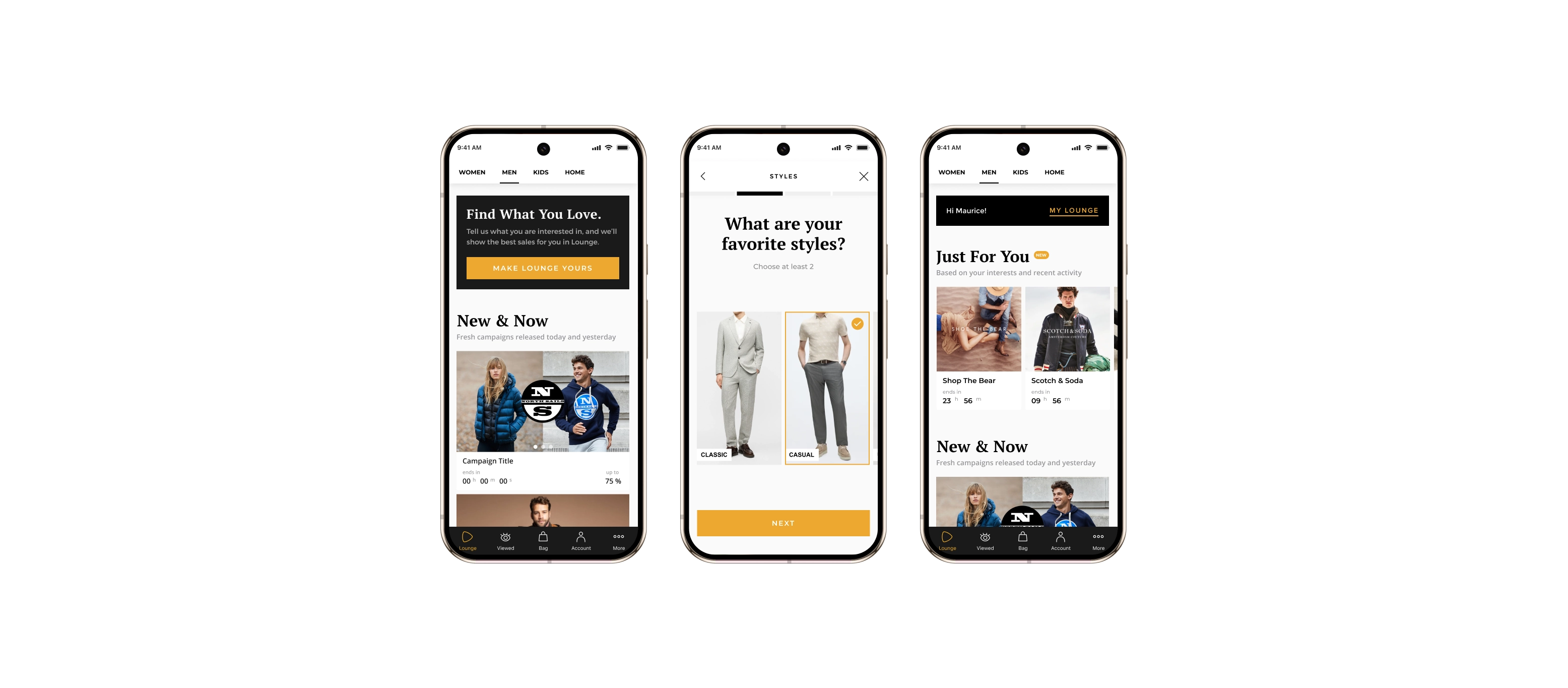
I led the 2019 redesign of Lounge’s home page. The research surfaced a deeper problem than navigation: the page treated every customer the same. The work on personal relevance outgrew the project, becoming a core pillar of the Lounge product.
Role
Design Driver, Personal Relevance Strategy
Company
Lounge by Zalando, Zalando Off-Price
Timeline
2019–2022
Team
2 PMs, 3 Designers, 1 Researcher, 5 Engineers, 2 Data Analysts
Summary
Lounge by Zalando is Europe’s largest flash-sale fashion platform: 2.5M monthly users across 20+ markets, campaigns that expire in 2 to 3 days. Users faced 35 to 45 campaigns a day, 1,000+ products each, ordered by recency. Position was the only factor driving clicks, so more than half landed on the top five. The catalog was set to scale past 100 campaigns a day. At that point this stopped being a UX problem and became a discovery gap with direct impact on conversion and GMV.
The business assumed personal relevance wasn’t realistic at Lounge. I used the 2019 redesign of the campaign view to prove otherwise. Personal relevance outgrew the project into a dedicated workstream, then became a core opportunity area of Lounge’s 2023 product vision.
Act I - The redesign that opened the question
01 / The Challenge
A homepage about to break under scale
My Lounge was the page every Lounge customer landed on after login: 35 to 45 live campaigns a day, sorted by freshness.
Position drove clicks, almost on its own. Campaigns near the top got the engagement, almost regardless of the content. With the business planning to scale the campaign volume significantly, relevant campaigns would only get buried deeper.
- 51%
- of clicks landed on the top five campaigns
- 34–45
- campaigns per day, sorted by freshness
- 80%
- of traffic on mobile
In 2018 a redesign of the campaign view had failed. Several A/B tests ran where the redesigned components performed significantly worse than the control.
2018 Redesign - Post-Mortem
The 2019 redesign needed to be rooted in research: no pixels until we understood the customer.
02 / Diagnosis
The brief was layout; the real problem was relevance.
The challenge was not just helping users navigate a large catalog quickly, it was making sure each customer saw first what mattered to them. Personalised experiences had become an established pattern in the industry, a capability Zalando had already validated on its core app.
Customer Problem
Heavy and light users alike were overwhelmed by the volume of daily campaigns. They struggled to find and discover the deals most relevant to them. The page surfaced the newest campaigns, not the right ones.
Business Opportunity
Personalisation was no longer a differentiator but an expectation. 59% of shoppers say it makes products easier to find, and 56% are more likely to return to stores that recommend well.
Data Constraint
The prevailing view was that personal relevance was out of reach at Lounge. The platform had no infrastructure to capture and process each customer’s implicit signals, so relevance had only ever meant sorting customers into broad groups.
“I can’t find anything I like”
The data unlock
Lounge lacked the data infrastructure and the ML capability to capture implicit signals and learn from customer behaviour.
But 70% of Lounge customers also shopped at Zalando’s main store, where rich preference data was already being used to produce recommendations. That overlap was the opening.
70%
of Lounge customers also shopped at Zalando main store, where their preferences were already known.
03 / The Reframe
Pursuing personal relevance
The sprint set out to help customers find relevant campaigns faster. Structural changes would help, but position drove clicks almost on its own, so the bigger lever was relevance: the right campaigns at the top, for everyone.
We interviewed experts from the team owning customer preference data at Zalando main store, and people at Lounge working on scattered initiatives trying to build relevance.
The question changed from “what data we don’t have” to “how can we leverage what we know about our customers to surface the deals most relevant to them”.
Decision · Where to start
The lead concept was a customisation flow asking customers to declare their preferences explicitly. Lounge had no way to learn from customer behaviour yet, and the data partnership that could change that was still only a conversation. Rather than wait on it, we pursued relevance with what was in reach.
We built a separate high-fidelity prototype for each participant, using their real browsing data. To test the value of a personalised experience, it had to feel real.
Validated
Customers recognised their own preferences in the prototype and found the personalised content valuable.
FOMO · The constraint
Customers worried that choosing preferences would hide everything they didn’t pick. They wanted relevance, but they still wanted to be surprised.
04 / The Proof
The data made customisation redundant
The work on the redesign led to a dedicated personalisation workstream at Lounge, which ran the first brand relevance experiment on the campaign overview, up-sorting campaigns based on the brands a customer already preferred.
- 01 · Positive results
- A statistically significant lift in Orders per User and a measurable drop in Exit Rate. The uplifts were small, but they proved the direction was right.
- 02 · Learning
- Brand was central to why people came to Lounge, but brand alone was not a strong enough signal to make the experience feel personal.
- 03 · Decision
- Customisation feature was dropped. It was the right move when we could not read behavioural data, and the wrong one once the partnership gave us real preference data.
So the 2019 redesign’s real output was not a new layout, but the data partnership that unlocked personal relevance at Lounge, and the team that emerged from it.
Act II - The strategy the craft earned
05 / The Strategy
The workstream becomes an opportunity area
In December 2020, Lounge launched its 2023 Strategy: eight opportunity areas to define the product vision for the next three years. The PM I’d worked with on the campaign view redesign and I became the strategy drivers for Personal Relevance.
Why this area carried the most weight
Personal Relevance was the broadest of the eight. Three of the others depended on it: Assortment Storytelling, Treating Best Customers Best, and Rewarding the New Customer.
- 8.6%
- 12-month retention: 3.8M active of 44M registered
- ~4 / 55
- campaigns engaged per session, in 6 to 7 minutes
- 300/wk
- campaign volume the business was scaling toward
The arithmetic was the case for the work. Stock was going broader and shallower, more lines, fewer units each. Campaign volume was climbing toward 300 a week. The same uniform list shown to every customer was becoming impossible to sustain, and the customers it served worst were the ones already leaving.
06 / The Constraint
Off-price personalisation is a different problem
Personalisation on the parent Zalando platform does not transfer to Lounge. Zalando works with deep, replenishable stock, so it can optimise around the customer alone. Lounge cannot: its stock is finite and its campaigns are short, only a few days each, so relevance has to help sell the stock that is live, not only suit the customer. That changes the question the model has to answer.
Zalando, full-price
“What is the best item for this customer?”
Infinite supply. Optimise for the person.
Lounge, off-price
“What is the best customer for the stock we have right now?”
Finite, fast-decaying stock. Optimise for both the person and the inventory.
With only minutes per session, the algorithm had to rank by chance of purchase, not by best match.
07 / The Frame
The three problems the team aligned on
I synthesised over ten prior research efforts, qualitative and quantitative, NPS and onsite feedback, into a single body of evidence that fed the problem-framing workshop. From it, we defined three clear, non-overlapping problems, each framed as a How Might We statement.
01
Recognition
HMW recognise each customer’s intent in the moment?
Supporting insight
Hunting for something specific, or browsing to get inspired.
02
Relevance + Excitement
HMW surface what is relevant and exciting, without narrowing the catalogue?
Supporting insight
From the FOMO tension: too-narrow relevance dulls discovery.
03
Unknown brands
HMW introduce brands they’d love but don’t yet know?
Supporting insight
Known brands sell out fast; the stock that lingers is from brands customers haven’t discovered.
The parent Zalando platform’s research team had already built a six-portrait segmentation. Rather than author our own, I selected the three that fit Lounge’s base and applied them.
08 / The Vision
From concepts to C-Level approval
Rather than solving the three problems within today’s constraints, we used them as the starting point to imagine the experience three years ahead, unconstrained and deliberately optimistic, then walked backwards to what could be built. Adapting Airbnb’s eleven-star method to a strategy problem, I framed four concepts as ten-star experience narratives. Not features. Pictures of what relevance could feel like at its most ambitious.
Concepts framed free of the present kept the vision from collapsing into incremental improvements.
A roadmap aligns a team for a quarter; a vision aligns a company for three years. Each narrative was rooted in a documented insight and one of the three customer portraits.
Seven editorial revisions and two C-Level approval cycles later, the vision and its concepts passed. I handed the Driver role to a Principal Designer, and the product groups took the concepts into delivery.
Coda
What shipped, and what it returned
The first feature built on the approved direction was Top Picks for You: a single curated campaign aggregating the most relevant products from across all live campaigns, the concept I had drafted as Curated Just for You.
Coda · Validation
+5% GMV
Around €100M at Lounge scale.
In the post-launch onsite surveys, satisfaction with the feature climbed from 38% to 61% as the team kept improving it:
“Saves me so much time! Top picks is top!”
“I love finding all different things from my favorite brands.”
“It’s very easy to come to this one sale and find something I like.”